
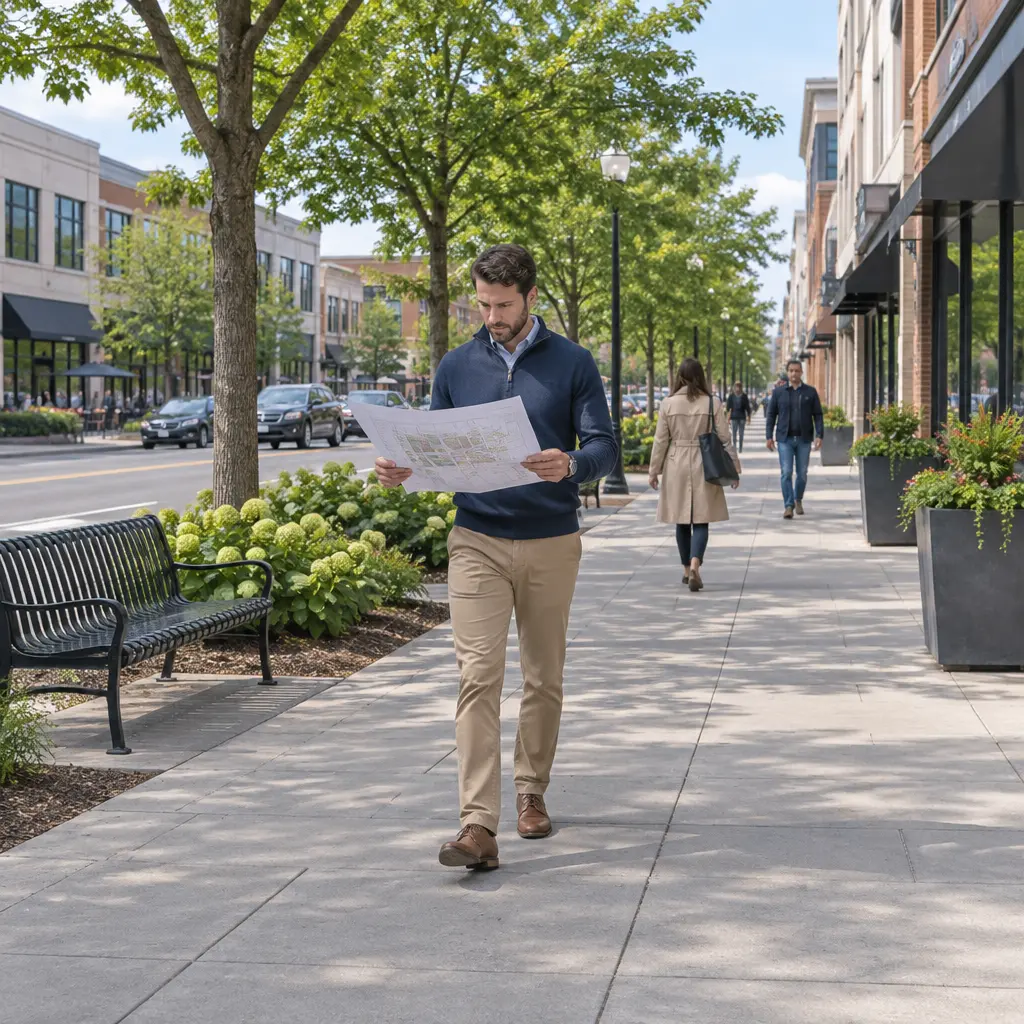
A business district is a concentrated area of commercial activity whose shops, services, workplaces, streets, and public spaces depend on one another to attract people and investment. Maintaining one over the long term means coordinating property owners, businesses, local government, and community groups to keep it safe, accessible, economically resilient, and welcoming—not simply keeping it clean. The International Downtown Association estimates that U.S. downtowns and center cities generate about 15% of national economic output while occupying roughly 3% of land, illustrating why their stewardship matters. Durable district management combines shared governance, diversified businesses, reliable maintenance, inclusive public spaces, transportation planning, and measurable performance.
Shared management sustains a business district’s long-term health
There is no single universal definition of long-term business-district maintenance. The International Downtown Association describes place management as the coordinated work of organizations and stakeholders that improve the vitality and economic performance of urban centers. In practice, that means managing a district as an interconnected place rather than as a collection of individual storefronts. A well-maintained district has a shared plan, dependable funding, active local businesses, accessible public spaces, and a way to assess results over time.
The relevant district types include central business districts, downtown commercial areas, neighborhood business districts, main streets, and business improvement districts (BIDs). Their scale and legal structure differ, but the same core challenge applies: public agencies and private stakeholders must coordinate services and investment while preserving the district’s usefulness to residents, workers, visitors, and businesses.
Use a shared plan and accountable governance
A district management plan is a written agreement on priorities, responsibilities, funding, and measures of progress. It should establish a shared vision and identify who is responsible for public-space care, business support, safety coordination, marketing, and capital improvements. The U.S. Small Business Administration’s guidance on business planning emphasizes setting goals, identifying resources, and reviewing performance; districts can apply the same discipline at a collective scale.
A representative management group should include small and large businesses, property owners, residents, workers, local government, and community organizations. This is particularly important where commercial rent, development pressure, or changing land use can affect who benefits from investment. Publish meeting decisions, budgets, service standards, and annual progress reports so that stakeholders can see how commitments translate into action.
Choose a stable funding model
A business improvement district is a defined area in which property owners or businesses fund supplemental services through an assessment, under authority established by local or state law. The International Downtown Association notes that BIDs commonly provide services such as cleaning, public-space management, marketing, and economic development beyond the baseline services supplied by local government. Other funding options include municipal budgets, grants, sponsorships, voluntary memberships, and public-private partnerships.
No single source should be assumed to remain sufficient indefinitely. A resilient budget distinguishes recurring operating costs from one-time capital projects, builds a reserve where legally and practically possible, and sets transparent rules for spending. Before adopting an assessment or renewal, consult affected stakeholders, check local requirements, and explain which services are additional rather than replacements for public responsibilities.
A diverse local economy strengthens a business district’s resilience
Economic resilience is a district’s capacity to withstand disruption, adapt to changing demand, and recover without losing its essential businesses and services. A varied mix of retail, food, professional services, housing, cultural uses, offices, and community-serving organizations can reduce reliance on any one customer group or industry. The U.S. Census Bureau’s County Business Patterns provides establishment and employment data that local managers can use to understand the structure of their business base.
A district’s performance is not measured only by new construction or visitor counts. Business openings and closures, storefront vacancy, employment, affordability, operating hours, and the availability of everyday services all contribute to a fuller picture. The International Downtown Association’s research on downtown recovery has documented uneven changes in office use and pedestrian activity since the COVID-19 pandemic, underscoring the need to respond to local conditions rather than assume a return to past patterns.
Support independent businesses and succession
Business retention is the work of helping existing firms remain viable, while business succession planning prepares owners to transfer or sell a firm when they retire or leave. District organizations can connect businesses with technical assistance, training, financing information, façade programs, and mentorship. The U.S. Small Business Administration offers counseling and support through its resource partner network, including Small Business Development Centers and SCORE.
Retention efforts should be practical and confidential: ask businesses about barriers, refer them to qualified support, and track whether common problems—such as permitting delays, lack of accessible loading, or rising occupancy costs—can be addressed collectively. A pipeline of local entrepreneurs, pop-up operators, and appropriately sized commercial spaces can also help fill vacancies without relying only on national chains.
Promote a useful mix of businesses and activities
A healthy business mix serves people at different times of day and across different income levels. Food and services, entertainment, childcare, cultural venues, offices, housing, and public institutions can create overlapping reasons to visit. The National Main Street Center’s Main Street Approach organizes revitalization around economic vitality, design, promotion, and organization—four connected areas that help communities strengthen local commerce while honoring local character.
District managers can map storefront uses, identify gaps, and coordinate seasonal events or shared marketing. They should also avoid treating every vacancy as a branding problem: some spaces may need flexible lease terms, code improvements, small-business assistance, or a change in permitted use before a suitable tenant can operate there.
Clean, safe, and accessible public spaces keep a business district inviting
Public-realm management covers sidewalks, streets, plazas, trees, lighting, signage, seating, and other shared spaces. Their condition influences whether people can reach businesses comfortably and whether they choose to stay. Maintenance is a continuous service, not a one-time beautification project: a district needs clear standards for litter collection, graffiti response, lighting checks, snow or heat response, landscaping, and repairs.
The National Association of City Transportation Officials’ Urban Street Design Guide treats streets as public spaces as well as transportation corridors. This perspective helps districts consider pedestrians, cyclists, transit users, deliveries, and people with disabilities together, rather than designing solely for vehicle movement.
Set visible standards for cleaning and repairs
A maintenance standard defines what should be done, how often, and how quickly a problem should be addressed. For example, a district can establish inspection routes, litter and graffiti response targets, a public issue-reporting channel, and a process for escalating hazards to the responsible agency. A service log helps managers identify repeated problems and distinguish routine upkeep from infrastructure failures requiring public investment.
Cleanliness can be measured through completed inspections, response times, unresolved reports, and stakeholder feedback. Measures should be paired with context: a high number of reports may reflect easier reporting rather than worsening conditions. Publish the standards and results so that residents and businesses understand the service being delivered.
Coordinate safety without displacing people
District safety is the reduction of preventable harm through a combination of environmental design, maintenance, outreach, emergency coordination, and appropriate public services. The U.S. Department of Justice’s National Institute of Justice describes Crime Prevention Through Environmental Design (CPTED) as using features of the physical environment to reduce opportunities for crime and improve perceptions of safety. Practical steps can include maintaining lighting, improving visibility, activating blank storefronts, and coordinating with local safety agencies.
Safety strategies should be lawful, evidence-informed, and respectful of civil rights. Train staff in de-escalation and referral, define when emergencies should be directed to public responders, and connect people who need assistance with qualified outreach and social services. Track both reported incidents and community perceptions, since neither measure alone captures the full experience of safety.
Make access and mobility part of daily operations
Accessibility means that people with different physical, sensory, and cognitive needs can reach and use the district’s businesses and public spaces. The U.S. Access Board’s accessibility standards address elements such as accessible routes, curb ramps, signs, and parking. District managers should audit routes and entrances, report barriers to the responsible owners or agencies, and include disabled people in planning and review.
Mobility planning should also coordinate transit access, walking, cycling, vehicle circulation, deliveries, and parking management. The National Association of City Transportation Officials recommends street designs that support safe, usable public space. Districts can test changes—such as loading zones, pedestrian space, or wayfinding—using temporary pilots, then evaluate effects on access, business activity, and safety before making permanent investments.
Measurement and adaptation preserve a business district over time
Long-term stewardship requires regular measurement and the willingness to revise plans. A baseline shows conditions before an intervention; repeated observations show whether conditions change. The U.S. Census Bureau’s American Community Survey and County Business Patterns, local licensing records, transportation counts, and district-level surveys can supply useful data, but each source has different definitions, time periods, and geographic limits.
A practical dashboard should combine economic, physical, access, and community indicators. Avoid relying on a single headline metric such as foot traffic: more visits do not necessarily mean that local businesses are thriving or that the district is serving its residents well.
Track a small, consistent set of indicators
Useful indicators include commercial vacancy, business openings and closures, employment, pedestrian counts, service response times, accessibility issues resolved, public-space condition, event participation, and perceptions of safety. Where possible, disaggregate results by location, business type, or time of day to identify who benefits and where problems persist.
The International Downtown Association’s work on downtown metrics encourages place managers to use consistent indicators to understand district performance. Establish definitions before collecting data, document changes in methods, and compare like with like. A short annual report can explain results, limitations, and next steps in plain language.
Plan for shocks and changing conditions
Resilience planning prepares a district for economic, environmental, and operational disruptions, including severe weather, infrastructure failures, public-health emergencies, and shifts in work or shopping patterns. The U.S. Environmental Protection Agency’s climate adaptation resources encourage communities to assess local risks and consider measures such as shade, trees, stormwater management, and heat preparedness. Appropriate actions depend on local hazards and infrastructure.
A district continuity plan can identify emergency contacts, communication channels, critical services, backup operating arrangements, and recovery priorities. Review it with businesses and public agencies, and update it after exercises or actual disruptions. Capital projects should be evaluated for lifecycle costs, maintenance responsibilities, and climate exposure—not only construction expense.
Learn from established place-management models
The National Main Street Center’s Main Street Approach offers a community-led model organized around economic vitality, design, promotion, and organization. Business improvement districts offer another model, using a defined governance and funding structure to provide supplemental services. These approaches are not interchangeable: communities should select a model that fits local law, capacity, geography, and stakeholder priorities.
Both models illustrate a useful principle: lasting improvements depend on consistent organization as well as visible projects. A street festival or façade program can help, but it is more durable when connected to an agreed economic strategy, ongoing maintenance, inclusive governance, and transparent evaluation.
Conclusion: Maintain a business district as a shared, evolving asset
A business district lasts when its stakeholders maintain a shared plan, dependable funding, a varied local economy, clean and accessible public spaces, coordinated safety practices, and reliable ways to measure progress. Governance and finance make the work accountable; business support and a balanced mix strengthen economic resilience; daily maintenance and mobility keep the place usable; and data-informed adaptation prepares it for change.
Local leaders can begin by establishing a representative working group, recording baseline conditions, agreeing on a short set of priorities, and publishing who will do what and how results will be reviewed. For further guidance, consult the International Downtown Association, the National Main Street Center, the U.S. Small Business Administration, and local planning and transportation agencies.
Sources: International Downtown Association, Downtown Value Index, https://downtown.org/downtown-value-index/; International Downtown Association, Place Management, https://downtown.org/place-management/; International Downtown Association, Downtown Recovery, https://downtown.org/research/; U.S. Small Business Administration, Write Your Business Plan, https://www.sba.gov/business-guide/plan-your-business/write-your-business-plan; U.S. Small Business Administration, Local Assistance, https://www.sba.gov/local-assistance; U.S. Census Bureau, County Business Patterns, https://www.census.gov/programs-surveys/cbp.html; National Main Street Center, Main Street Approach, https://mainstreet.org/about-main-street/the-main-street-approach; National Association of City Transportation Officials, Urban Street Design Guide, https://nacto.org/publication/urban-street-design-guide/; National Institute of Justice, Crime Prevention Through Environmental Design, https://nij.ojp.gov/topics/articles/crime-prevention-through-environmental-design; U.S. Access Board, ADA Accessibility Standards, https://www.access-board.gov/ada/; U.S. Census Bureau, American Community Survey, https://www.census.gov/programs-surveys/acs; U.S. Environmental Protection Agency, Climate Change Adaptation Resource Center, https://www.epa.gov/arc-x