
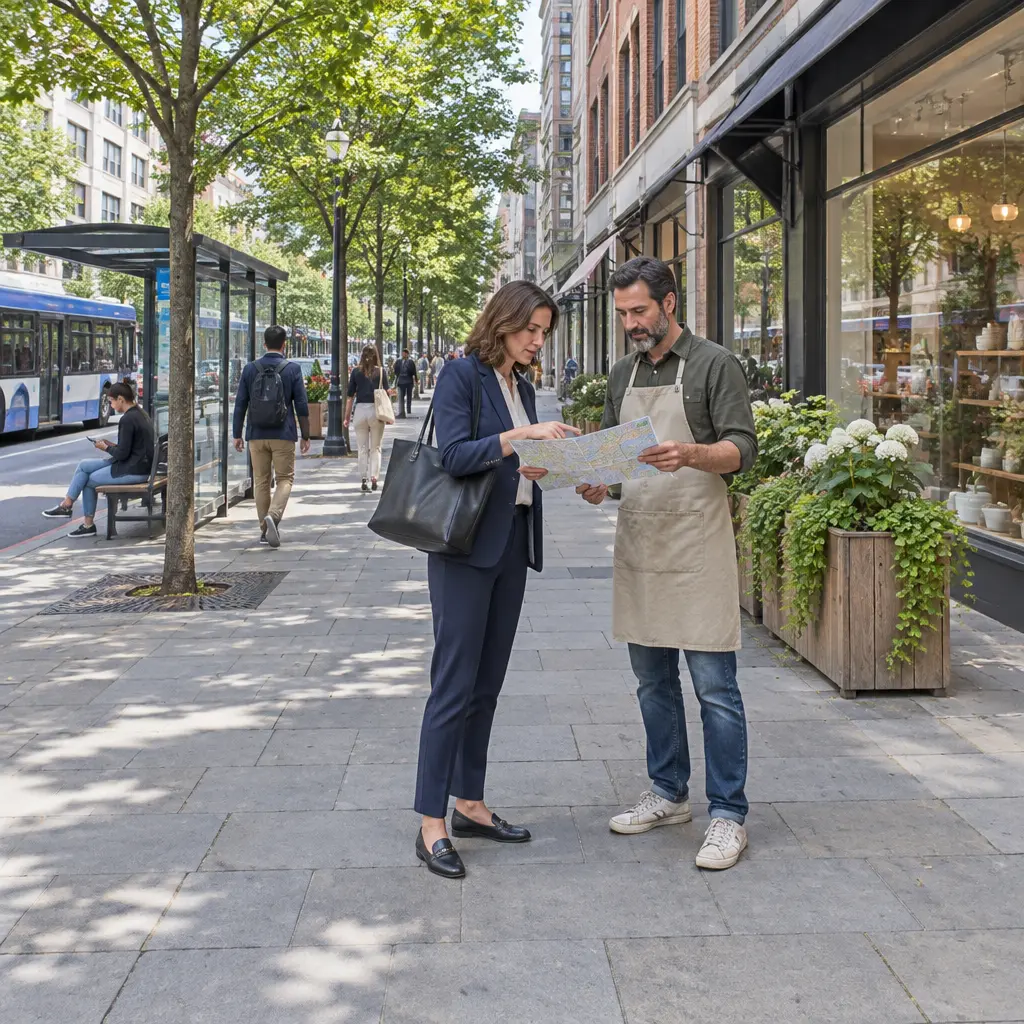
Business districts provide the places, infrastructure, and coordinated services that help businesses operate and people work, shop, and access daily needs. Depending on the district, these services can include transportation and parking, utilities and waste management, public safety, business support, property development, and amenities such as dining and public spaces. Their role matters at a time when more than 80% of Americans live in urban areas, according to the U.S. Census Bureau’s urban–rural classification, and when local organizations such as business improvement districts coordinate services beyond those a city may provide. The sections below explain how business districts support operations, manage shared spaces, and strengthen local economies.
Business District Services: Definition and Scope
A business district is a geographically concentrated area where businesses, offices, retail establishments, and related services cluster. The term can describe a central business district, a neighborhood commercial corridor, an industrial area, or a designated business improvement district (BID). These forms differ in purpose and governance: a central business district is a land-use and economic center, while a BID is generally a defined area where property or business owners fund supplemental services through an organized program.
The International Downtown Association describes place management as the coordinated work of organizations that help districts function as attractive, economically active places. In practice, services vary with local needs, available funding, and the authority of the organizations involved. A BID generally supplements—not replaces—municipal services such as policing, street maintenance, and fire protection.
The scale of urban concentration helps explain why these services matter. The U.S. Census Bureau reported that 80.0% of the U.S. population lived in urban areas under its 2020 classification. Business districts concentrate jobs and customers within this wider urban system, making reliable access, clean public spaces, and functioning infrastructure especially important.
Business Districts Provide Operational and Infrastructure Services
Operational services enable businesses to open, receive goods, serve customers, and meet basic building needs. Many are delivered by city agencies or utility providers; district organizations may coordinate, advocate for, or add services to address local gaps.
Transportation, Parking, and Access
Access services connect workers, customers, residents, and deliveries to district businesses. They include public transit connections, sidewalks, street crossings, cycling facilities, parking management, loading zones, wayfinding, and transportation information. District managers may work with transit agencies and municipalities to identify service problems, promote alternative travel, and organize events that affect traffic or curb use.
The U.S. Department of Transportation’s National Household Travel Survey documents the importance of travel for work, shopping, and other daily purposes. The appropriate access mix depends on the district: a dense downtown may prioritize transit and walking, while an industrial district may need freight access and truck staging. These services are connected to public-realm management because safe, legible streets can make nearby shops and workplaces easier to reach.
Utilities, Waste, and Building Support
Utility and building services include electricity, water, sewerage, telecommunications, street lighting, recycling, refuse collection, and upkeep of shared facilities. Utilities are typically supplied or regulated by public agencies and private providers, rather than by a district organization itself. A BID or business association can help businesses report outages, coordinate collection schedules, communicate construction impacts, and advocate for infrastructure improvements.
Reliable utilities are essential to everyday operations: restaurants need water and waste removal, offices depend on power and communications, and retailers require safe, well-lit premises. The U.S. Environmental Protection Agency’s ENERGY STAR program notes that commercial buildings account for a substantial share of U.S. energy use, underscoring why efficiency upgrades and resilient building systems can matter across a concentrated business area.
Safety, Cleanliness, and Maintenance
District maintenance services can include sidewalk cleaning, graffiti removal, landscaping, litter collection, lighting checks, public-space repairs, and outreach to people in need. Public safety remains primarily a responsibility of law enforcement, emergency services, and other public authorities, but district organizations may support safety through ambassadors, visitor assistance, reporting systems, and coordination with city agencies.
These services are most effective when responsibilities are clear and complementary. For example, an ambassador can report a broken light or direct a visitor, while the relevant public agency handles repair or emergency response. The International Downtown Association’s research on downtown management describes cleaning, safety coordination, and visitor services as common activities among place-management organizations.
Business Districts Provide Business and Economic Development Services
Beyond physical operations, districts help businesses find customers, navigate local systems, and adapt to changes in the economy. These services range from direct technical assistance to marketing and long-term development planning.
Business Advice, Networking, and Permitting Guidance
Business support services help firms start, grow, and solve operational problems. They may include referrals to small-business advisers, workshops, peer networking, information about permits and regulations, hiring resources, and introductions to lenders or technical-assistance providers. District organizations usually do not issue government permits; instead, they help business owners understand requirements and connect with the agencies that do.
The U.S. Small Business Administration’s network of Small Business Development Centers provides counseling and training to entrepreneurs and small businesses. A district can make such support more accessible by hosting advisers locally or publicizing available programs. This is particularly valuable for independent businesses that have fewer in-house resources than larger firms.
Marketing, Events, and Visitor Information
Marketing services promote a district as a destination for shopping, dining, employment, and cultural activity. Common activities include business directories, maps, seasonal campaigns, public events, social media, and visitor information. Coordinated promotion can help customers discover businesses beyond the most visible streets and can support local events that bring foot traffic to an area.
For example, New York City’s Department of Small Business Services administers the Avenue NYC program, which provides targeted assistance to commercial corridors. Its approach illustrates how place-based support can combine neighborhood marketing, business outreach, and organizational capacity-building rather than relying on advertising alone.
Real Estate, Investment, and Workforce Connections
Economic development services address the district’s longer-term ability to attract businesses, investment, and workers. They can include commercial vacancy tracking, property-owner outreach, redevelopment planning, workforce partnerships, and coordination around construction or public projects. District organizations may connect developers with local priorities, but land-use approvals and infrastructure decisions generally remain with public authorities.
The U.S. Bureau of Labor Statistics’ Quarterly Census of Employment and Wages provides employment and wage data by industry and geography that local planners can use to understand economic conditions. Such evidence can help districts identify which sectors are expanding, where workforce partnerships may be useful, and how major changes could affect small firms and commercial property.
Business Districts Provide Public-Realm and Community Services
A district’s shared environment influences whether people can comfortably spend time there. Public-realm and community services connect the district’s economic role with accessibility, social activity, and neighborhood quality of life.
Public Spaces, Placemaking, and Accessibility
Placemaking services improve streets and shared spaces so that people can use them for movement, rest, and community activity. Examples include seating, trees, planters, public art, pedestrian improvements, temporary street closures, and accessible routes. Depending on ownership and local rules, a district organization may maintain or program these spaces, while the municipality retains responsibility for public rights-of-way and accessibility standards.
The National Association of City Transportation Officials’ Urban Street Design Guide emphasizes that streets serve multiple users, not only vehicles. This principle is relevant to business districts because walking, transit access, deliveries, and outdoor activity compete for limited street space. Good design can make those uses safer and more predictable.
Community Partnerships and Social Services
Community-facing services coordinate businesses with residents, nonprofit organizations, social-service providers, and government agencies. They may include outreach to unhoused people, referrals to health or social services, community meetings, youth programs, and communication about construction or local events. These programs work best when district organizations connect people with qualified service providers instead of attempting to replace specialized public or nonprofit services.
This partnership approach recognizes that business activity and community well-being are linked. A district with clear referral pathways can respond more constructively to complex needs while helping businesses and visitors understand whom to contact for assistance.
Resilience and Emergency Coordination
Resilience services help businesses prepare for disruptions such as extreme weather, power failures, public-health emergencies, and major construction. District organizations can share preparedness guidance, maintain business contact lists, coordinate recovery information, and relay local concerns to emergency-management agencies. They may also encourage measures such as backup power, flood protection, and continuity planning, while emergency response remains the responsibility of authorized agencies.
The Federal Emergency Management Agency’s Ready Business program offers planning resources for business continuity and hazard preparedness. In a concentrated district, shared communication can help firms receive consistent alerts and coordinate recovery, particularly when a disruption affects multiple blocks or essential infrastructure.
How Business District Services Are Organized and Evaluated
Services are organized through different models, including municipal departments, chambers of commerce, merchant associations, downtown partnerships, and BIDs. Funding may come from public budgets, membership dues, grants, sponsorships, or special assessments. A district’s legal authority and revenue structure determine what it can deliver directly and what it can only coordinate or advocate for.
Evaluation should match services to measurable outcomes. Useful indicators include business openings and closures, commercial vacancy, cleanliness inspections, response times for maintenance requests, event attendance, pedestrian activity, transit access, and business satisfaction. The International Downtown Association’s research and industry surveys provide frameworks for comparing management activities, while local data helps determine whether services meet the needs of particular businesses and communities.
A simple service map or scorecard can clarify which agency is responsible for each need, how to report problems, and how performance will be reviewed. This reduces confusion between supplemental district programs and essential public services, and supports transparent decisions about funding priorities.
Conclusion
Business districts provide interconnected operational, economic, public-realm, and community services. Transportation and utilities enable businesses to function; maintenance and safety coordination support usable shared spaces; business assistance and marketing strengthen local commerce; and partnerships improve accessibility, resilience, and community connections. Because delivery varies by district and governance model, businesses and residents should identify which services are provided by local government, utilities, and district organizations. Reviewing a district’s service plan, performance measures, and community partnerships is a practical next step toward making these places more effective and inclusive.
Sources: U.S. Census Bureau, 2020 Census Urban Areas Facts, https://www.census.gov/programs-surveys/geography/guidance/geo-areas/urban-rural.html; International Downtown Association, Research and Resources, https://downtown.org/research/; U.S. Department of Transportation, National Household Travel Survey, https://nhts.ornl.gov/; U.S. Environmental Protection Agency, ENERGY STAR Portfolio Manager: Commercial Buildings, https://www.energystar.gov/buildings; U.S. Small Business Administration, Small Business Development Centers, https://www.sba.gov/local-assistance/resource-partners/small-business-development-centers-sbdc; New York City Department of Small Business Services, Avenue NYC, https://www.nyc.gov/site/sbs/neighborhood-development/avenue-nyc.page; U.S. Bureau of Labor Statistics, Quarterly Census of Employment and Wages, https://www.bls.gov/cew/; National Association of City Transportation Officials, Urban Street Design Guide, https://nacto.org/publication/urban-street-design-guide/; Federal Emergency Management Agency, Ready Business, https://www.ready.gov/business.